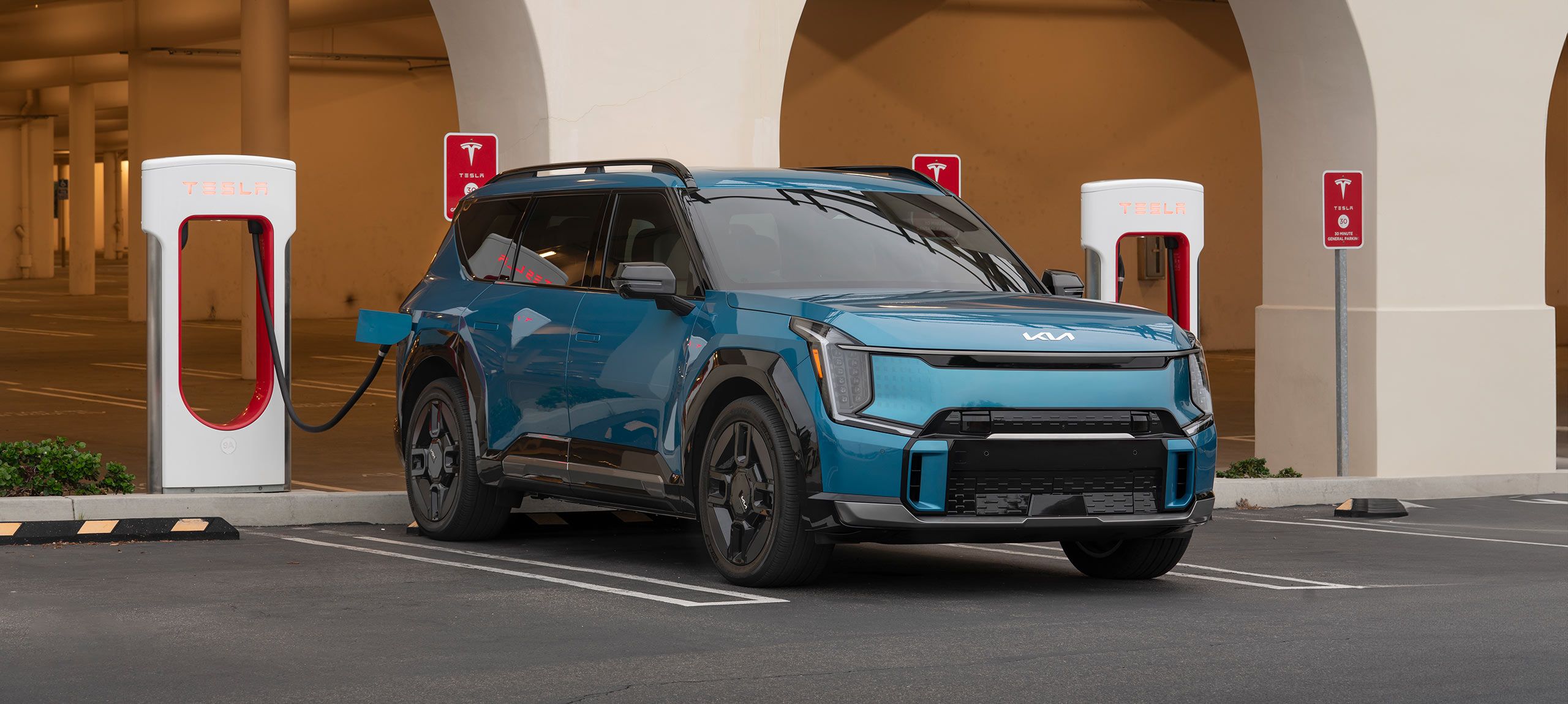
The U.S. now has more than 80,000 public DC fast-charging ports, but plugging in at the country's biggest network costs more than it did a year ago. Charging data firm Paren's report for the third quarter of 2026, published Oct. 13, counts 80,964 fast-charging ports at 14,614 stations, the first time the total has passed 80,000.
The national average price for fast charging was 54 cents per kilowatt-hour in the quarter, up 0.4% from the second quarter and 2.7% from a year earlier. Paren attributes the increase to Tesla. Prices at non-Tesla networks have held near 53.3 cents per kWh for five straight quarters.
Tesla's prices rise while other networks hold steady
Fast-charging prices, Q3 2026
| Price measure | Per kWh | Change vs. Q3 2025 |
|---|---|---|
| National average | $0.540 | +2.7% |
| Tesla, non-member | $0.569 | +15% |
| Tesla, member | $0.396 | +9% |
| Non-Tesla networks, average | About $0.533 | Flat for five quarters |
Source: Paren, U.S. EV Fast Charging Q3 2026 report.
The non-member rate is what drivers pay at a Supercharger without a Tesla membership plan, and it now sits above the average at other networks. That matters for a growing pool of drivers outside Tesla. Kia, for example, says the EV9 has a built-in NACS port that gives it access to more than 30,000 Tesla Superchargers.
Where you charge matters as much as who runs the charger. Hawaii was the most expensive state at 87.7 cents per kWh and Nebraska the cheapest at 42.4 cents. At stations that use time-of-use pricing, peak rates averaged 63.7 cents, up 4.3% from a year earlier, while off-peak rates averaged 43.8 cents. About 27% of per-kWh stations now price by time of day.
Fewer new sites, but bigger and faster ones
Construction has slowed. Networks opened 664 stations with 4,106 ports in the third quarter. Through September, the industry added 2,158 stations and 12,354 ports this year, about 20% fewer stations and 9% fewer ports than in the same period of 2025.
The new sites are larger and more powerful. Non-Tesla stations built in the quarter averaged 5.0 ports, up from 4.1 a year earlier, and 73% of all new ports were rated at 250 kilowatts or more, up from 60%. Among non-Tesla networks, 35% of new ports were rated at 400 kW or higher, up from 10% a year ago.
Tesla still built the most, adding 1,287 Supercharger ports, or 31.3% of the quarter's total, plus 124 ports through its Supercharger for Business program. Ionna added 378, Walmart 344, Red E 202, Electrify America 186 and ChargePoint 169. Tesla's share of all U.S. fast-charging ports fell from 54.3% to 49.3% over the past year. Paren cautions that Ionna's total is inflated because it counted converted former Circle K sites as new.
Geography is uneven. Urban markets received 90% of new stations, according to Electrek's reading of the report, and rural markets got 68 of the 664. California led with 87 new stations, followed by Texas with 66.
Record use, steadier reliability
Drivers charged more than ever this summer. Paren counted 50.4 million fast-charging sessions in the quarter, up 26% from a year earlier, including a record 17.6 million in July. Because the number of ports grew at a similar pace, average utilization barely moved, at 15.9% nationally compared with 15.8% in the second quarter. Los Angeles was the busiest metro area at 31.8%.
Reliability inched up. Paren's national score was 93.9, compared with 93.7 a year earlier, and 50 of 52 states and territories scored 90 or higher. Oklahoma had the lowest score, at 80.8, and Montana the highest, at 97.4.
For EV drivers, the practical advice is simple: check the price in the app before you plug in, especially at a Supercharger without a membership, and use off-peak hours where a station offers them.